

I’m a rational person, but 10 days of silent meditation does strange things to the human mind.
It’s the 9th day, and I’ve just finished the most demanding meditation of the day. I go to stretch my legs in the nearby small forest. I often walk during my free time, but this time, it’s one of the most unusual walks I’ve experienced in my life.
I walk just as I always do and observe the trees, but this time they all look different. I see happy trees, sad trees, some playful, others confident, and there is one really depressed birch. I’m genuinely feeling their emotions. In that moment, these weren’t just trees, but they felt like people. I was touched.
I’m a rational human being, so feeling what fellow trees are feeling was more than surprising.
My rationalisation: It’s a silent retreat with any kind of interaction forbidden, so the need for entertainment and human connection played with my perception. Recently, I read a great fiction book, A Treatise on Shelling Beans. The protagonist once said he could tell which trees in the forest were sad and which were happy. It must have come to my mind to apply that perspective on that day.
It felt like being a kid again. Walking is fun, eating is fun, and looking at trees is fun. After 10 days, everything is vivid, perception is much sharper, and I’m more focused on everything I do.
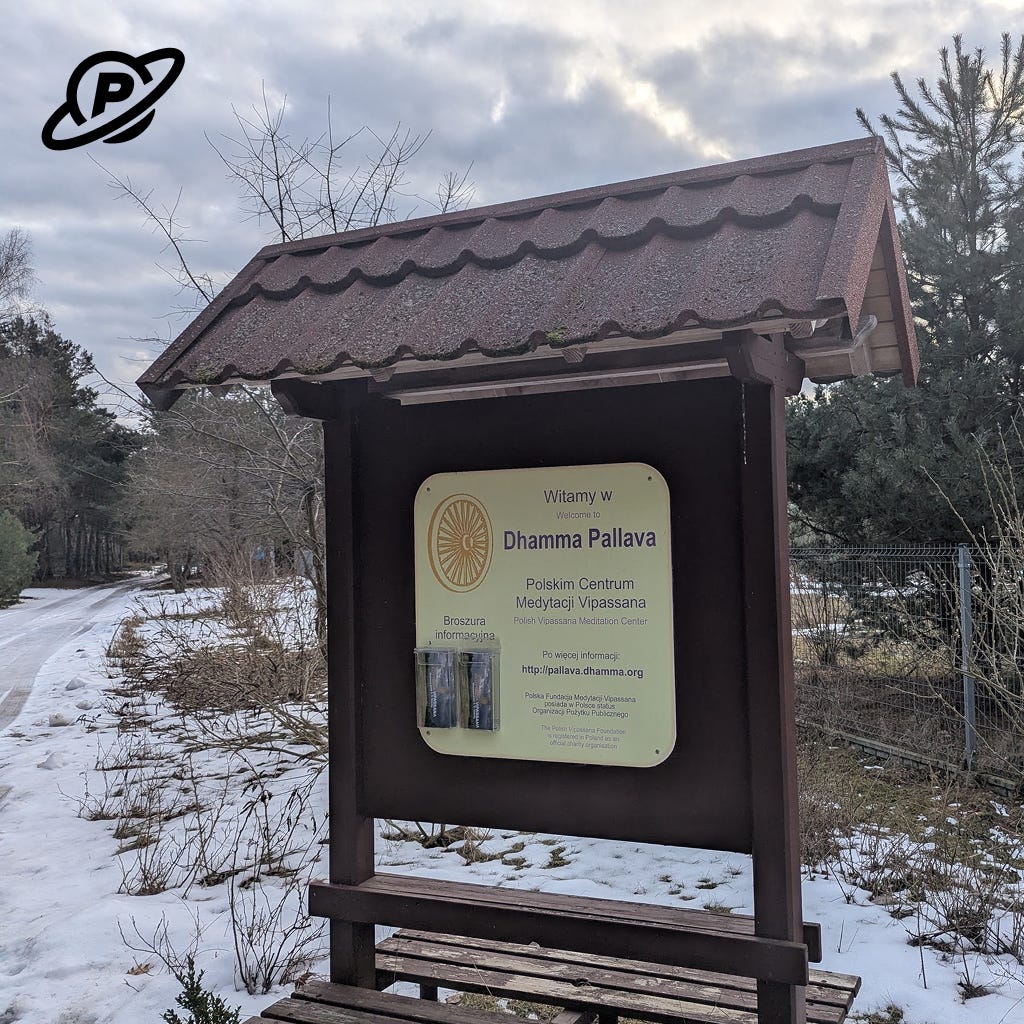
Lessons
Last year, I explained a few aspects of meditation experience and how it’s designed to gradually make you more focused. All these aspects are still valid:

Today, I share lessons that influenced me the most during my second time there. I’ve already described an experience of “feeling trees”, but there’s more to it:
Understanding Ego
I heard many times:
“People are focused only on themselves.”
“No one really pays attention to what you are doing.”
“No one will notice your triumphs and disasters.”
I know it, but I still operate as if it’s not true. It’s called the spotlight effect, where people believe they are being noticed more than they really are.
I understood it during the retreat, as it’s a practice of being invisible to others. No one sees how you tied your hair, no one pays attention to how you sit. They may hear if you cough loudly when the hall is absolutely silent, but people will ignore you as much as you ignore others.
Before the retreat, I had one of the most productive periods in my career. So moving to a state where nothing happens was hard to accept. For the first few days, I wasn’t happy that everything was happening in slow-motion. I wasn’t happy with people putting their peanut butter on so slowly. I let it go after the 3rd day, when I joined and started walking much slower.
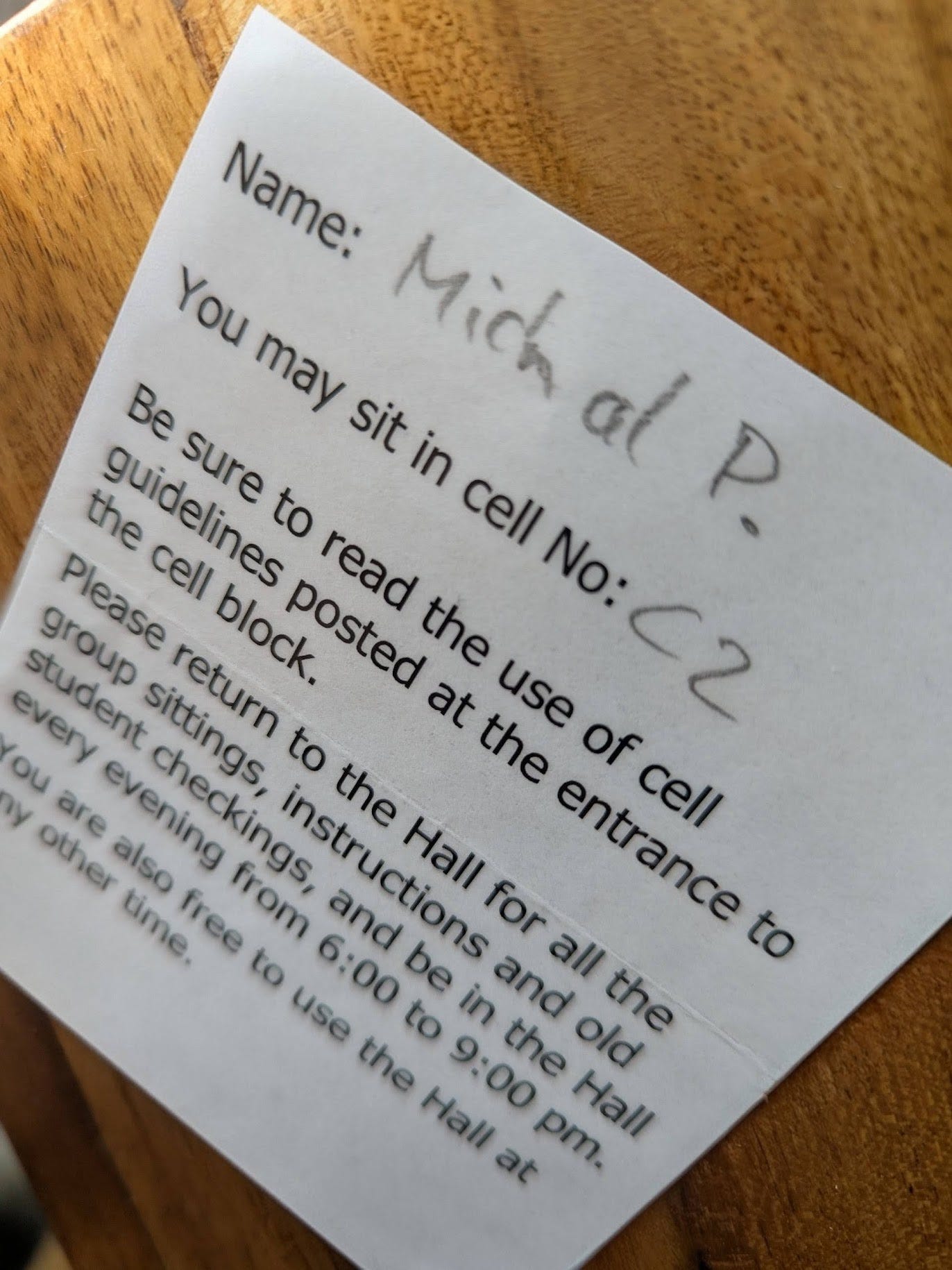
But my ego started to look for a new spotlight. When you are an old student, someone who has done it at least once before, you can get a meditation cell. It’s a small room, 2 by 1 metres, completely dark, where you can meditate in dedicated periods of time. A hard realisation came in the morning on the 4th day when I saw that some people around me got special notes with an assigned cell, but I didn’t!
I was frustrated: what should I do to get it? So, do I need to come here next year, too? I told my friends that this time, as an old student, I would have a cell. Dealing with these thoughts fast was part of the practice. Then, after one day of sorrow, I got my cell number assigned on the 5th day, which felt like a promotion. Now, I know it was all about my ego in action
Take-outside: Detecting my ego moments remained with me after the retreat, and I notice them more often. You barely exist to people around you, but my ego was having fun even when an audience wasn’t there.
Accepting Pain
Each session, once every few minutes, and frequently at the end, my brain would say:
“Hey Michał, it’s your body. It’s painful, so it’s time to change your position.”
“No one will notice that you moved, and the pain will be reduced.”
It’s our default to avoid painful things. When it hurts, I want to stop it.
The most demanding parts of the retreat are the “sittings of strong determination.” You sit with your eyes closed and don’t move. You can straighten your back a bit and swallow, but that’s it.
I never knew how much time had passed because I had my eyes closed during the whole session. But it gets increasingly more difficult to sit with the pain after the first half of the session. After 45 minutes had passed, I began to believe that 60 had definitely passed! I believed the teacher had forgotten to turn on the recording.
During these sessions, you recalibrate your relationship with the pain you perceive. The key is to act as a scientist and examine it. You try to understand what kind of pain it is, where it appears, which places are connected, etc. You can stop the body scan for a few moments in painful places, but then you continue to scan the body anyway. It transforms how the brain experiences pain. Knowing it can simply move on to observe different parts of the body makes the pain much easier to bear.
The leading theme of the retreat is the realisation that everything changes, everything passes, nothing is permanent. This concept is called anicca in Buddhism. All the sensations you feel right now in your body are appearing and disappearing. Pain disappears, too.
Being in a state where you know it hurts a lot, but you can control it, is a feeling I’ll never forget. A few times, I sat longer to observe how amazing it is to fully control the pain. I sat for even 10 minutes more than others! (It’s my ego, but at least I noticed it).
Take-outside: You can accept the pain you feel. You can also wait until your emotions pass. You don’t have to react in the moment. Everything changes.
Passing Time
My mind was bothering me with questions. I kept hearing these questions at least 30 times every hour:
“Is it already 45 minutes, maybe less? Maybe more?”
“For sure it’s coming to an end soon, right? I bet 50 mins have passed.”
“How much time does it take me to do a body scan?”
I spent approximately 11 hours every day sitting in the meditation hall. I didn’t have my watch, just an alarm clock in my room. There is one wall clock in the hallway, visible before entering the meditation hall, and a second one in the kitchen. Two clocks and the gongs, which rang a few minutes before the next events on the agenda.
In the beginning, it was frustrating to try to guess the time passing every few minutes.
Some sessions passed quickly, especially when I got lost in thoughts, but others took years!
I often felt huge disappointment when I saw the clock in the hallway during breaks, and it was much earlier than it felt.
At the end of the retreat, I realised that it’s counter-productive to constantly bother myself with thoughts and questions about time. I stopped paying attention to passing time. I was just there, in the moment (well, maybe except for the 5:30 AM sessions, as I was looking forward to breakfast. I fasted from 11:30 AM the day before). As Buddhists say, the present moment is the only thing we have. Past and future don’t exist.
Take-outside: Thinking about time doesn’t influence its passing. The more attention you pay to tracking the time, the slower it passes.
Final Thoughts
Dedicating 10 days of one’s life to sit and meditate feels like madness. But it’s an investment. Understanding how our brains work pays dividends. I plan to get back to that place once a year.
According to the teachers, the only measurement of progress during this kind of meditation is how equanimous your brain is. This means that you are at peace with it, and you are observing its calm state. It’s similar to the prosoche concept of Stoic awareness, which is watching one’s mind the way a scientist watches an experiment, but we were focused on observing any kind of sensations inside the body, not tracking thoughts.
It doesn’t matter what kind of sensations you are feeling in your body, or if you can focus for much longer.
The goal is to have a calm and peaceful mind. One that dissolves your ego, accepts the pain, and detaches from passing time.
The most common question I got this year was: “How does it differ from last year?” Well, it was stronger this year. I felt the emotions of my friends: the trees.
Thanks for reading,
— Michał
Connect
LinkedIn | Substack DM | ADPList | X | Bsky
Podcast
Homepage | Spotify | Youtube | Apple Podcasts | Castbox | Pocket Casts
Thank you so much for this inspiring article. The section on pain during meditation feels particularly familiar to me from my own daily practice, and I often find myself simply sitting more comfortably instead of accepting the slight discomfort, enduring it, and waiting to see what happens. I believe that’s the most valuable insight, as you’ve already described: that everything passes. For me, it’s like a wave, it comes and goes. How calming.