

One of the most amazing things for me is that writing helps us to see our own thoughts. We can witness how our reasoning changes over time and keep a record of our state.
I write a lot. I publish these articles weekly. During my time as a staff engineering manager, I sent hundreds of important messages to hundreds of engineers. The quality of our communication influences the quality of our work, with writing at its centre.
Now, producing and writing content requires much less effort with AI. LLMs are taking over both sides, creating text and summarising it. The situation is that AI is sitting in the middle of human communication.
MIT study from 2025 stated that using AI to write essays weakens brain connectivity and memory recall, leading users to feel detached from their work and unable to remember what they wrote. The study was conducted on a small group but warns us about the cognitive decline.
We are losing skills that we are not using, and that’s atrophy. I listed timeless skills to focus on practising and saving from decline. Writing is here to stay, and should be protected from decline.
The private version in the form of journalling or documenting your own decisions is about understanding yourself. It’s equally important to be understood by others. Same tool, different challenge.
Here is a timeless writing framework that will help you communicate clearly. It consists of 3 steps:
Prepare (Why/What/Who)
Write simply
Remove unnecessary words
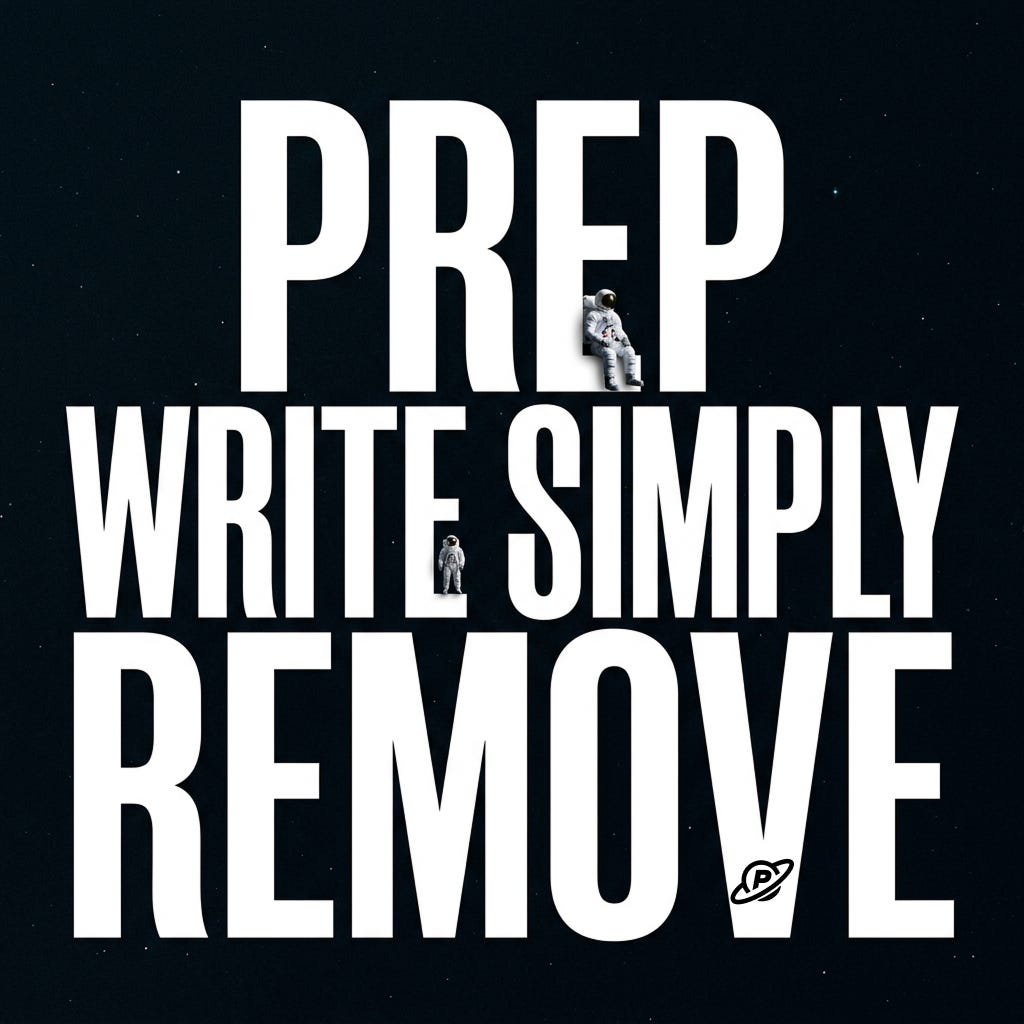
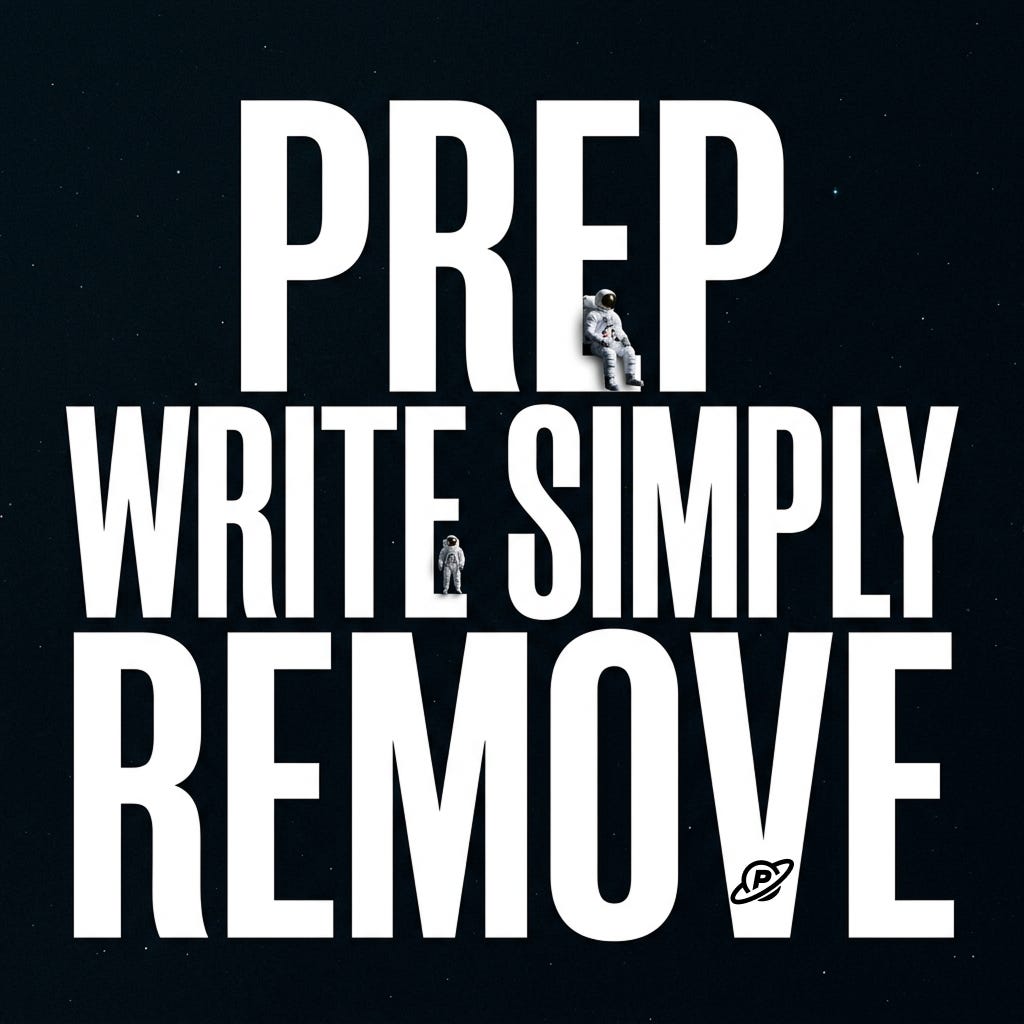
Writing Framework
1. PREPARE (Why/What/Who)
You don’t need to prepare if you’re writing for yourself, but writing for others is different. We lack the full knowledge of what others know or think. Preparation gives you a perfect start for framing the communication.
Think about the basics:
Why are you writing the communication?
What would you like to achieve with the message?
Who is your audience?
Why
There must be a reason why you started writing. Find it, and when it’s important, then include it in your message.
When the reason for your writing is to vent your frustration, it is better to wait until you have calmed down. Being aware of the purpose is the starting point for writing and setting its tone. You would write differently to celebrate success than to give a heads-up that the company is not doing well.
Example reasons:
Because your team missed a deadline and you need to write an update to stakeholders.
Because you are frustrated by the work of the supporting team and want to share feedback.
Because a new bonus scheme is going to be introduced and you want to give your team a heads-up.
Sounds silly to state the obvious? Maybe, but writing things down helps to clarify and name what we’re dealing with.
What
You have to know what your goal is so you can work towards achieving it. Defining your goal gives your message direction.
Imagine that your goal is to communicate that the team needs to level up their estimation skills, as they have been significantly off for the last three sprints. However, you end up just praising their good work with only a vague comment on estimation skills, and no reader sees it as an important issue after reading the message.
Examples of starting goals:
The goal is for your team to follow new rules.
The goal is to successfully communicate the change.
The goal is to share praise and make your employees feel recognised.
A clearly stated goal helps you focus on one thing.
Who
When writing for others, it’s difficult to predict their interpretations. You’ll use different words while writing for someone technical vs. a business person.
“We migrated to Flipper, a new feature flag gem on our Ruby backend.” This is clear for Ruby developers, quite clear for engineers (gems are Ruby libraries), but difficult to understand for non-technical people in the company.
Examples of different audiences:
Business people in the company: non-technical and without an understanding of engineering.
The support team: interested in learning all the scenarios that you have already tried out before engaging with them.
Fellow managers: know most of the things that you know and have similar context.
Your engineers: highly interested in what happens in your team, and technical.
Each of these example groups requires a different level of detail, different context and vocabulary. It’s important to understand what they know.
The more you know about your audience, the better, because it helps you avoid things that they will not understand.
2. WRITE Simply
When you are speaking, you use much simpler words. Apply this to writing. Because of a cognitive load, we want to be energy efficient when speaking. Complicated words and complex sentences use more brain resources than simple ones. When your reader is tired and low on brain resources, it is difficult to understand complicated communication.
Simple words do not reflect a simple mind. It’s the exact opposite.
What is easier to understand?
We are revising the protocol for merging pull requests: henceforth, a single approval will be requisite for a merge, as opposed to the previous stipulation of two. This adjustment reflects our increased confidence in your expertise and is intended to expedite our processes.
or:
“We are changing the current rule for merging our pull requests: you now need at least one approval to merge your changes, instead of two approvals — we trust you, and we want to move our things a bit faster.“
Our brains think using stories. To lower cognitive load, write as the brain operates. Use an active form instead of a passive one. So, “I pushed to production” instead of “The production has been updated by me”. It is easier for the brain to follow.
The style and structure of the message are important, and for more than a few sentences:
Put the most important passage first.
Organise it in a readable format, and avoid a wall of text.
Use three to four sentences per paragraph.
3. REMOVE Unnecessary Words
Many words do not add important information. The fewer words you use, the less processing power your reader needs to understand the message. Just like a garbage collector in a runtime environment, use your common sense to run one over your text.
Simplification makes it easier to understand and saves time for readers.
Example: “We are changing the current rule for merging our pull requests: you now need at least one approval to merge your changes, instead of two approvals — we trust you, and we want to move our things a bit faster”
After removing (subjectively) unimportant words: “We are changing the rule for merging pull requests: you need one approval, instead of two— we trust you, and we want to move faster”
Every day, when I write simple messages using tools like Slack, I pause before clicking the send button and remove unnecessary words. In this article, I removed a few dozen words.
Summary
The Lindy Effect is a phenomenon that states that the future life expectancy of some non-perishable things is proportional to their current age. If the technology of writing has been with us for a few thousand years, it’s likely to stay for another few thousand years.
When writing for others, prepare and think about why you need to write the message, what your goal is, and who your audience is. Then, keep it simple and write as you speak. Finally, remove words that are not needed.
Thanks for reading,
— Michał
Post Notes


Discover Weekly
Content which I’ve read recently:
Podcast (Live Sessions)
Homepage | Spotify | YouTube | Apple Podcasts | Castbox | Pocket Casts
Connect
LinkedIn | Substack Profile | TopMate | X | Bsky