

There is a mathematical solution to a specific kind of decision-making problem, with a 36.8% success rate, to maximise your chance of picking the best option. It helps when deciding on hiring people or buying a house, but it’s applicable whenever you’re choosing from a sequence of options and can’t go back.
Imagine the following decision-making problem:
you need to pick only one option
you have N options to go through
you need to review each one sequentially
you must make a decision before moving on
you can’t change your decision once made
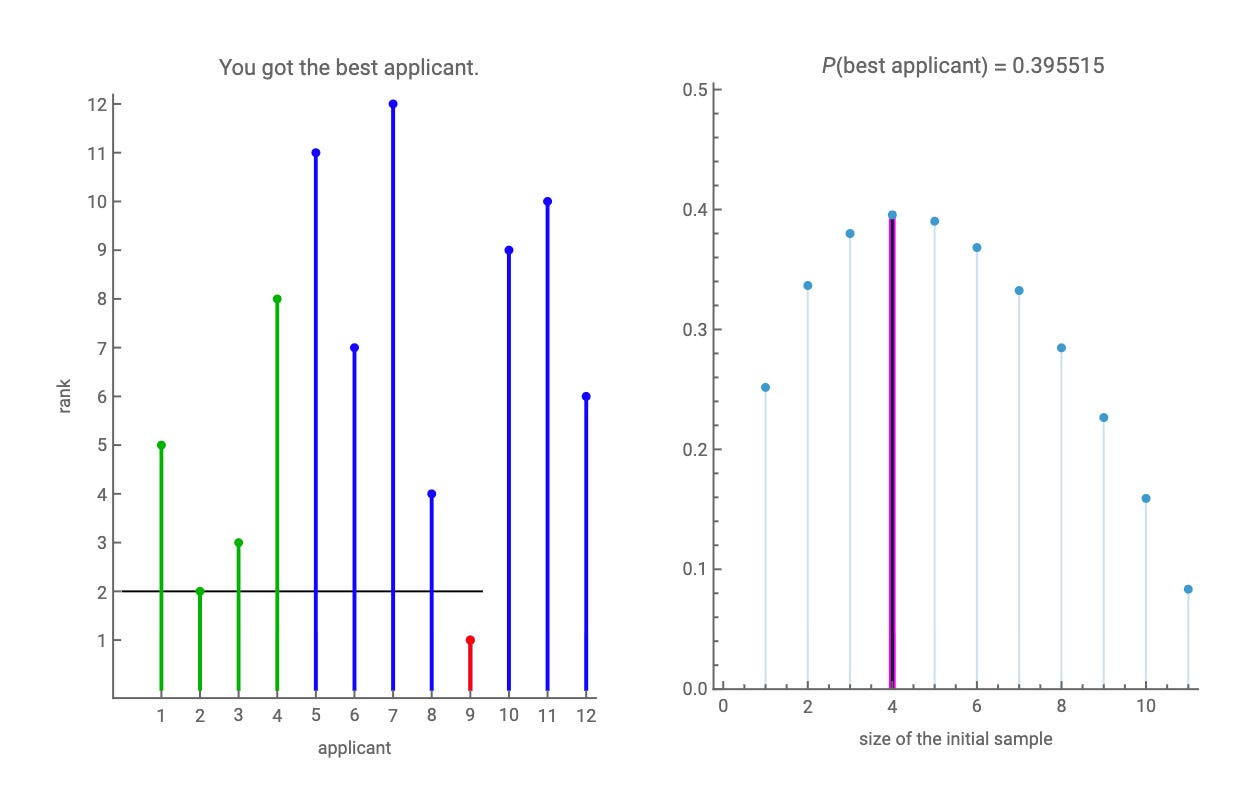
For example, you’re hiring one new engineer to your team, and you have 12 candidates to go through. After each interview, you must decide if you will hire them or not, and this decision is final.
Solution
According to the mathematically calculated probability, assuming you have 12 candidates in random order:
you should review 4 of them (12 × 37%, rounded to 4)
you reject them all but remember the best
if the next candidate is better, you hire them immediately
if not, you continue on to the next one
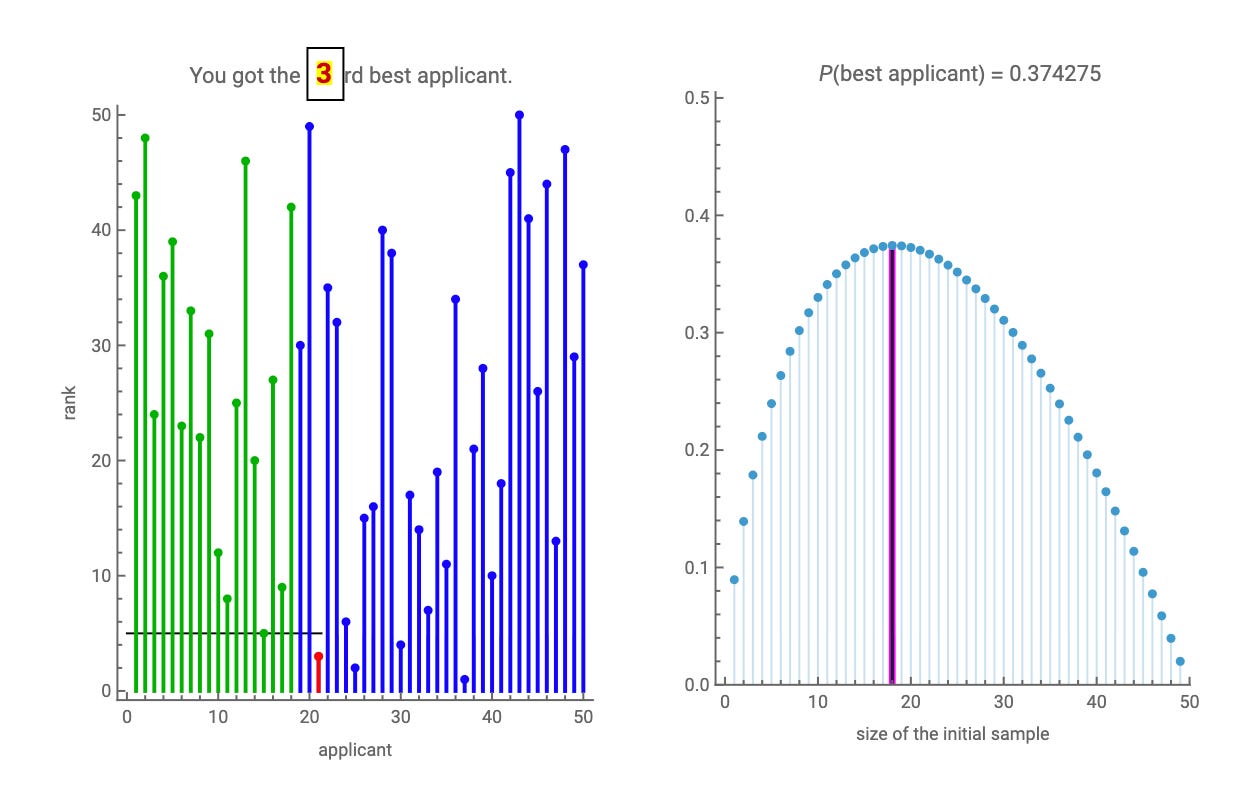
This is known as the secretary problem, and the math behind it points out that the probability of selecting the best applicant is 1/e ≈ 0.368 (for a large enough sample: 0.368 is the limiting value when N→∞). It’s a probability of success, not a guarantee.
Yes, you can end up with the last candidate when the best one was in the initial calibration pool, which is why it’s a probability, not a guarantee.
Why
First, you only review at the beginning, which frees up brain resources because you don’t have to make any decisions yet. It forces you to reject the first 37% of options, but it gives you an overview of the pool, which is especially useful when exploring new domains.
In reality, scenarios shaped by the secretary problem are difficult to reproduce, but it leaves us with important lessons:
When you stop calibrating too early, you don’t have a benchmark
When you calibrate for too long, you risk losing the best candidate
Use the first 37% for calibration. Then the probability is on your side.
While hiring, I often reviewed a few candidates without making immediate decisions. Throughout my career, I tried to avoid making decisions until I had a good sense of the initial pool of options.
The tricky part is to know when to stop, and here the 37% rule helps.
Thanks for reading,
— Michał
P.S. You can play with visualisations of the problem at WOLFRAM Demonstrations Project. Some of my trials:
Post Notes
Discover Weekly
Content worth your time:
Podcast (Live Sessions)
Homepage | Spotify | YouTube | Apple Podcasts | Castbox | Pocket Casts
Connect
LinkedIn | Substack Profile | TopMate | X | Bsky
Interesting.
This also suggests that, if you are hiring for employee number 9 for a role where you already have 8 others, just hire the first one that you come across that is similar to those you already have.
In this case, you use the previous 8 as calibration set and you go straight to hiring for number 9.
If you adhere strictly to the rule and hire “the next best”, you will, in time, also raise the level of the whole team, avoiding the natural downward drift of hiring “similar, good enough candidates” instead.