

The Lenses series collects thoughts that shift how you see things.
Enjoy today’s lenses.
Books
In my whole life, I have known no wise people (over a broad subject matter area) who didn’t read all the time — none, zero. You’d be amazed at how much Warren reads — and at how much I read. My children laugh at me. They think I’m a book with a couple of legs sticking out.
As Charlie Munger noticed, wise people read a lot and my circle of friends seems to agree with it. It might be correlation (which doesn’t imply causation), causation or both. I believe “what kind of books” also plays its role in this process.
I was about to fail my default goal of 24 books a year miserably. By the beginning of October, I had read only 7 books. October became my best month on record, with 7 books, and with 4 more in November I’m almost back on track.
That record month brought an important realisation. Spending time with a book feels like an antidote to short, thin formats. Summaries of wisdom in a few words or sentences can work, can be useful. But it’s impossible to replace a few hours focused on one topic together with a book. The difference in perceived acquisition of new concepts is far greater. My partner is a bookworm. She reads around 50 books a year, so I have access to a vast library of titles, and a good example to read more often.
How many books did you read this year?
Hard Core
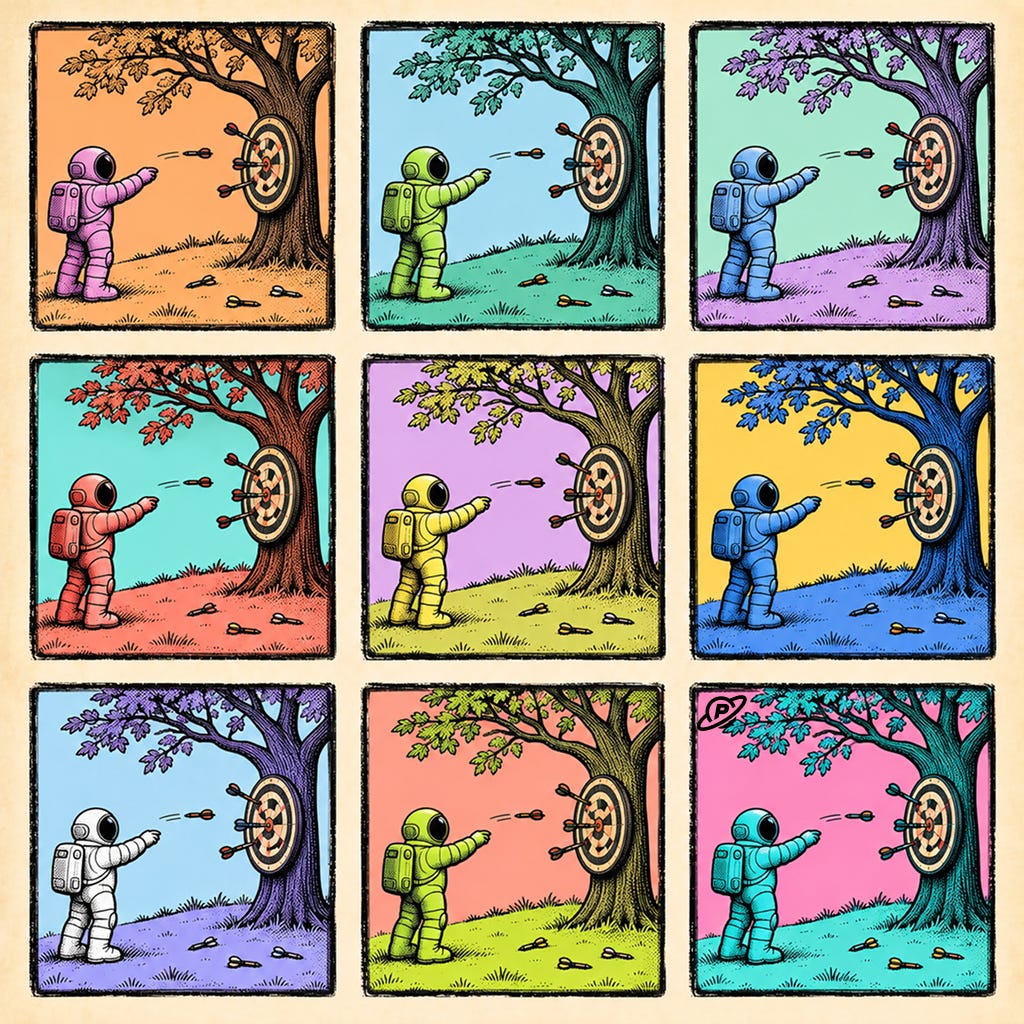
Many problems have a hard core at the center, surrounded by easier stuff at the edges. Working hard means aiming toward the center to the extent you can. Some days you may not be able to; some days you’ll only be able to work on the easier, peripheral stuff. But you should always be aiming as close to the center as you can without stalling.
Picking easier stuff at the edges is my flaw, and it’s Paul Graham’s version of bikeshedding. It reminds me of aiming in darts. What perspective he adds is that on some days we can’t aim at the centre, and the word “some” is key. Spend too many days at the edges, and the core is lost.
Do you aim at the hard core?
Writing
If you’re thinking without writing, you only think you’re thinking.
My journey with preaching about the value of writing started a few years ago. I started with a monthly experiment: a daily 30-minute timer, no Internet, no apps, just one writing file. I wrote about what had happened and listed ideas. Soon, these notes became seeds for possible articles or talks. I no longer follow that strict form, but I still write for at least 10 minutes a day. I encourage you to try this experiment.
Writing is an amazing tech. It helps you to distil your thoughts, not necessarily for the public, just for yourself.
When was the last time you sat down and wrote for yourself for 30 minutes?
Thanks for reading,
— Michał
Post Notes


Podcast (Live Sessions)
Homepage | Spotify | YouTube | Apple Podcasts | Castbox | Pocket Casts
Connect
LinkedIn | Substack Profile | TopMate | X | Bsky
The writer Umberto Eco belongs to that small class of scholars who are encyclopedic, insightful, and nondull. He is the owner of a large personal library (containing thirty thousand books), and separates visitors into two categories: those who react with “Wow! Signore professore dottore Eco, what a library you have! How many of these books have you read?” and the others — a very small minority — who get the point that a private library is not an ego-boosting appendage but a research tool. Read books are far less valuable than unread ones. The library should contain as much of what you do not know as your financial means, mortgage rates, and the currently tight real-estate market allows you to put there. You will accumulate more knowledge and more books as you grow older, and the growing number of unread books on the shelves will look at you menacingly. Indeed, the more you know, the larger the rows of unread books.
–– Nassim Nicholas Taleb The Black Swan